Preparing for ACT Fire & Rescue should start with a map of the whole pathway, not a remembered fitness score. An application can need attention in several places at once: eligibility evidence, reasoning practice, communication and physical preparation. This guide explains how to organise that work without turning an unsupported stage number or an old benchmark into a rule.
The requirements below use the current career-service facts. FirePrep’s preparation suggestions are coaching advice, not additional selection criteria. For broader planning, use the ACTFR service page, the ACT recruitment overview and the College pathway guide.
How the assessments fit together
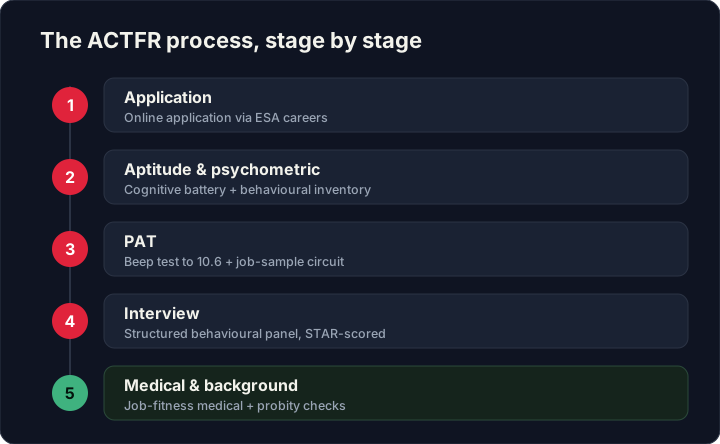
Use the selection sequence above to organise your preparation. If a stage number elsewhere differs, confirm the actual assessment and attendance arrangements in your invitation rather than relying on the ordinal alone.
FirePrep recommends keeping an application checklist, a physical-training log and an examples bank together. That makes it easier to see an administrative gap alongside a training gap, instead of discovering it only after an invitation arrives.
Application and eligibility
Start with work rights and driving evidence. Applicants must be Australian citizens or permanent residents. source review overdue (review due 2026-10-07); confirm the current candidate information pack. An unrestricted Australian C licence plus completed Heavy Vehicle Knowledge Assessment, or an unrestricted Australian MR licence, is required. source review overdue (review due 2026-10-07); confirm the current candidate information pack.
The ACT-specific clearance also needs attention. An unrestricted current ACT Working With Vulnerable People card is required. source review overdue (review due 2026-10-07); confirm the current candidate information pack. Make a record of the documents you hold and any question you need recruitment to resolve. Do not substitute another jurisdiction’s card or licence guidance for the ACT requirement.
For campaign planning, the current position is: The advertised 2026 intake closed on 2 August 2026. source review overdue (review due 2026-10-08); confirm the current candidate information pack. That is not evidence of an annual opening date, a recurring application window or a guaranteed course place. Check the live vacancy and prepare documents without inventing a countdown.
FirePrep recommends checking that names and dates match across your records, drafting concise work-history notes and saving the submitted version of your application. Confirm any qualification or age question not answered here with recruitment rather than assuming another service’s rule applies.
Online assessment preparation
Online verbal, numerical, abstract and spatial reasoning plus written/video answers; verification may follow. source review overdue (review due 2026-10-08); confirm the current candidate information pack.
Build your practice around the domains actually named, rather than importing the test battery of another service. For numerical work, review both the calculation and how you interpreted the question. For verbal questions, distinguish what a passage states from what seems plausible. For abstract and spatial work, explain the transformation you used before checking the answer.
FirePrep recommends alternating untimed learning with timed practice. Keep an error log that separates knowledge gaps, misreading and pacing. Practise clear spoken and written explanations too, but do not memorise an artificial persona or claim that a particular response guarantees a score.
Shuttle run and group assessment
beep test level: ≥ 9.6 level — Reach level 9.6 in the 20-metre shuttle run. source review overdue (review due 2026-10-07); confirm the current candidate information pack.
FirePrep recommends practising controlled turns and pacing alongside gradual aerobic development. A practice result is information about preparation, not an official assessment result. Avoid attaching a fixed improvement timeline to every candidate: training history, health and recovery differ.
Group assessment includes teamwork and an introductory interview. source review overdue (review due 2026-10-08); confirm the current candidate information pack.
For group preparation, practise listening, clarifying the task and making a useful contribution without taking over. When discussing a past team experience, explain your own actions and what changed because of them. These are communication recommendations, not a claim about unpublished marking weights.
Physical aptitude preparation
Candidates progressing through selection undertake the ACTFR Physical Aptitude Test. source review overdue (review due 2026-10-07); confirm the current candidate information pack. Current medical consent is required for physical abilities testing. source review overdue (review due 2026-10-07); confirm the current candidate information pack.
The published task outline helps you plan more specifically than a generic gym checklist:
In order: balance, ladder climb, tower climb, height anxiety, sensory deprivation, hose drag, container lift, hose hold/advance, hydraulic carry, teammate rescue. source review overdue (review due 2026-10-08); confirm the current candidate information pack.
Hose-drag task uses a 50m hose reel. source review overdue (review due 2026-10-08); confirm the current candidate information pack. Wear long sleeves, full-length trousers and closed footwear; no sleeveless tops, hats or sunglasses. source review overdue (review due 2026-10-08); confirm the current candidate information pack.
Detailed task loads, deadlines and penalties beyond the published outline below are not confirmed here. Do not borrow them from another service’s circuit. FirePrep recommends progressive carries, lower-body strength, controlled pulling and aerobic work adapted to your current ability. Hazardous height, sensory-deprivation or equipment work belongs in an appropriately supervised setting, not a homemade test.
Interview, referees and checks
Formal interview, referee checks, occupational medical and psychometric assessment precede appointment. source review overdue (review due 2026-10-08); confirm the current candidate information pack. A police character check is required during selection. source review overdue (review due 2026-10-07); confirm the current candidate information pack.
FirePrep recommends a bank of genuine examples involving teamwork, learning, difficult decisions and responding to feedback. Use a situation–task–action–result structure, but spend most of the explanation on what you actually did. Rehearse follow-up questions rather than memorising a speech.
Medical and background decisions are not something a training score can predict. Follow the requested disclosure and evidence instructions, and ask the recruiting team about individual circumstances instead of self-diagnosing eligibility from an online checklist.
Training and the next phase
Paid 20-week training at Hume; graduate as Third Class Firefighter on probation. source review overdue (review due 2026-10-08); confirm the current candidate information pack.
If introductory and training guidance give different timing, clarify the actual course dates before making leave or accommodation commitments.
ACTFR facilitates HR licensing before probation ends. source review overdue (review due 2026-10-08); confirm the current candidate information pack. First Class qualification takes approximately 24 months; continuing training is required. source review overdue (review due 2026-10-08); confirm the current candidate information pack.
Think beyond assessment day: practise consistent study habits, accepting correction and balancing training with recovery. The College pathway guide develops those planning questions. The FirePrep readiness check can help organise your next preparation priorities; it cannot confer eligibility or predict an appointment.