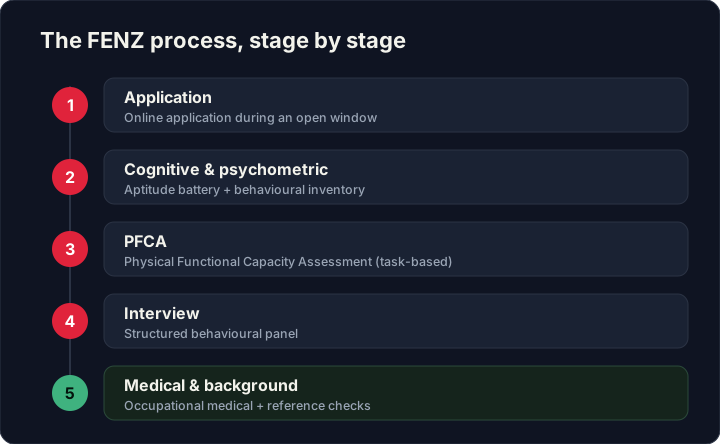
The useful way to map FENZ recruitment is to identify each demand and prepare for it deliberately. Reasoning practice does not replace physical preparation; a fast physical circuit does not settle the other physical components; and polished interview answers do not replace honest evidence.
This guide uses the current career service facts for requirements and separates them from FirePrep coaching advice. It does not invent a fixed stage count or assume that the headings below are the exact scheduling order for your campaign. Follow your current invitations for appointments and instructions.
Orient yourself before applying
National recruitment generally twice yearly, taking 6–9 months; usual courses January/April/July/September. source review overdue (review due 2026-10-08); confirm the current candidate information pack. Published round is closed and feeds September 2026 training; advertised testing dates are historical. source review overdue (review due 2026-10-08); confirm the current candidate information pack.
Keep the general recruitment pattern separate from the status of a particular round. A historical testing date is not an appointment for a future campaign. The FENZ service page and official careers material are useful starting points; the broader pathway guide covers cross-Tasman preparation and the physical tasks in more detail.
Application and eligibility
Applicants must be New Zealand/Australian citizens or have New Zealand permanent residency. source review overdue (review due 2026-10-07); confirm the current candidate information pack. Applicants must be at least 18; there is no maximum age. source review overdue (review due 2026-10-07); confirm the current candidate information pack.
Create a document checklist from the current application itself. Check names, contact details and the evidence requested. A complete upload list or licence condition is not confirmed here; use the application instructions rather than substituting an Australian service’s rules.
FirePrep recommends keeping a copy of what you submit. Later interview examples and disclosures should remain consistent with that account.
Cognitive assessment and work preferences
Ten-minute online GAS and ten-minute supervised verification: numerical, verbal, deductive and abstract reasoning. source review overdue (review due 2026-10-08); confirm the current candidate information pack. Work-preference questionnaire precedes formal interview; no right/wrong answers. source review overdue (review due 2026-10-08); confirm the current candidate information pack.
For reasoning practice, review your method as well as the final answer. If you misunderstand a question, slowing down briefly may help more than doing another timed set. If the concept is unfamiliar, study it before trying to improve speed.
Answer the work-preference questionnaire honestly. FirePrep does not recommend memorising a supposed ideal profile or assuming that another provider’s practice assessment reproduces the live test.
The PPT: more than a timed circuit
The PPT includes job-related tasks, a separate strength/endurance assessment, and heights/confined-space assessments. Passing the timed circuit alone does not satisfy the complete PPT. source review overdue (review due 2026-10-07); confirm the current candidate information pack. ppt job circuit seconds: ≤ 495 seconds — Complete the eight job-related PPT tasks in 495 seconds or less. A seven-minute rest follows before the strength/endurance component. source review overdue (review due 2026-10-07); confirm the current candidate information pack.
Circuit: approximately 16kg BA and gloves; 30m transition walks between designated tasks. source review overdue (review due 2026-10-08); confirm the current candidate information pack.
FirePrep recommends progressive conditioning that develops carrying, pulling and repeated effort alongside aerobic fitness. A running result alone does not demonstrate readiness for the task protocol, and a gym substitute is not an official test.
Strength total at least ten; no zero; at most one marginal score. Grip/deadlift use measured body-mass category. source review overdue (review due 2026-10-08); confirm the current candidate information pack. Current guide rounds body mass up to the next category; 62kg uses 65kg. The older chart uses different rounding. source review overdue (review due 2026-10-08); confirm the current candidate information pack.
This article does not reproduce the full current body-mass scoring table. Use FENZ’s current instructions rather than an older chart to assess the applicable category and score. The FENZ pathway guide explains the published exercise protocols without inventing missing scores.
Separate height test on 10.5m ladder and dark confined-space instruction test are required. source review overdue (review due 2026-10-08); confirm the current candidate information pack.
Use appropriate supervision for familiarisation. Do not recreate hazardous height or confined-space conditions at home.
Practical assessment and interview
Approximately three-hour practical centre: communication, teamwork, problem solving, adaptability and instructions. source review overdue (review due 2026-10-08); confirm the current candidate information pack.
Practise listening to a brief, checking your understanding and making a useful contribution. As FirePrep advice, aim to help a group complete its task rather than trying to look like its leader. That is a preparation principle, not a published merit formula.
Approximately one-hour behavioural/situational interview with up to three panel members. source review overdue (review due 2026-10-08); confirm the current candidate information pack.
Prepare behavioural examples with clear ownership: what was your role, what did you decide and what happened? Practise aloud and ask a partner to probe gaps. Flexible familiarity with your experience is more useful than a script that breaks when the question changes.
Medical, references and other conditions
Two work-related online referee checks. source review overdue (review due 2026-10-08); confirm the current candidate information pack. Police vetting examines convictions, charges and relevant information; agency assesses suitability. source review overdue (review due 2026-10-08); confirm the current candidate information pack.
Keep contact information current and disclose accurately. Do not assume that a story about another candidate establishes how your circumstances will be assessed.
FENZ funds initial medical; usual GP examination plus audiology appointment. source review overdue (review due 2026-10-08); confirm the current candidate information pack. GP medical and occupational-health review determine individual fitness; do not infer eligibility from a diagnosis alone. source review overdue (review due 2026-10-08); confirm the current candidate information pack.
Organise relevant records and follow the clinician’s instructions. Coaching cannot determine medical suitability.
Conditional offer requires police/security, medical, references, work rights and appointment-review clearance. source review overdue (review due 2026-10-08); confirm the current candidate information pack.
From selection into training
PPT revalidation occurs just before recruit-course commencement. source review overdue (review due 2026-10-08); confirm the current candidate information pack. Paid 12-week Rotorua residential course; meals/accommodation supplied. source review overdue (review due 2026-10-08); confirm the current candidate information pack.
Keep a sustainable routine while waiting for confirmed course instructions. Think about leave, household responsibilities and the practical transition into study as well as assessment-day performance.
The FirePrep readiness check can help you identify a preparation priority. Treat that result as coaching guidance, not a FENZ pass, employment offer or medical clearance.