A useful NTFRS preparation plan starts with the published sequence and the evidence needed at each point. It should not depend on claims that an intake is unusually small, that another service is easier, or that a particular regional posting is inevitable.
The requirements in this guide come from the current career service facts. FirePrep’s preparation suggestions are coaching advice, not additional selection rules. Use the NTFRS service page, Northern Territory overview and current candidate instructions alongside this map.
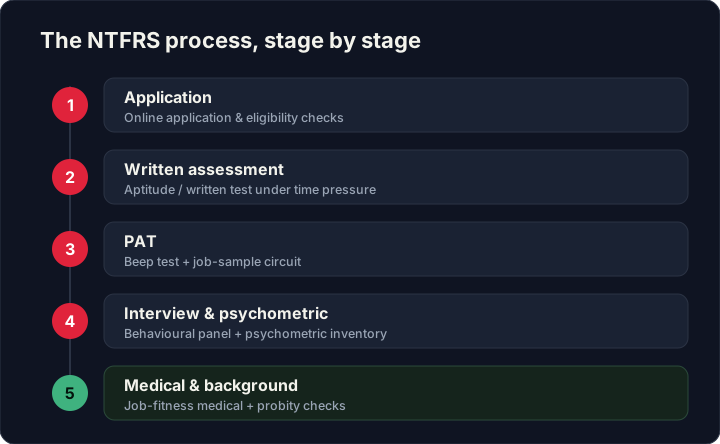
Sequence: application, beep, written/psychometric, PAT, panel/referees, medical. source review overdue (review due 2026-10-08); confirm the current candidate information pack.
Application and eligibility
The official landing page invites applications but provides no calendar deadline; consult its current vacancy link. source review overdue (review due 2026-10-08); confirm the current candidate information pack.
Begin with the vacancy actually advertised, then check your evidence:
Australian citizenship, permanent residency or New Zealand citizenship. source review overdue (review due 2026-10-08); confirm the current candidate information pack. A current unrestricted manual driver licence is required. source review overdue (review due 2026-10-07); confirm the current candidate information pack. Year-12/equivalent, trade/tertiary qualification, or two-year full-time work plus life/interpersonal skills. source review overdue (review due 2026-10-08); confirm the current candidate information pack.
Online application: declarations, cover letter, resume, certified documents. source review overdue (review due 2026-10-08); confirm the current candidate information pack.
Check certification and readability before uploading documents. FirePrep recommends using concrete examples in your cover letter and keeping a copy of the application so later answers remain consistent.
Keep later deadlines separate from what is needed now:
A manual MR licence recognised by the NT Government is required at least one week before recruit-course commencement. source review overdue (review due 2026-10-07); confirm the current candidate information pack. Current first aid is required at least one week before course, not at application. source review overdue (review due 2026-10-08); confirm the current candidate information pack.
Build those into your planning when course instructions are available. Do not assume they are qualifications you can leave until recruit training.
Beep test
beep test level: ≥ 9.6 level — Reach level 9.6 in the recruitment beep test. source review overdue (review due 2026-10-07); confirm the current candidate information pack.
As a FirePrep recommendation, aim for repeatable fitness rather than a single best effort. Combine progressive aerobic work with recovery and technique practice under the current testing instructions. That is a training strategy, not an additional official cutoff.
The beep-test comparison guide can help cross-applicants organise separate requirements; another service’s warning or retest rules should not be imported into NTFRS.
Written and psychometric assessment
Verbal, numerical and abstract reasoning, personality and reading assessments. source review overdue (review due 2026-10-08); confirm the current candidate information pack.
Practise the published areas and review the reason for each error. Do not assume that repeated timed tests will fix a concept you have not understood. Answer personality questions honestly, and follow the actual assessment instructions rather than a generic proctoring checklist.
Written-assessment failure: recommended reapplication after 12 months. source review overdue (review due 2026-10-08); confirm the current candidate information pack.
The distinction between a recommendation and a mandatory exclusion matters. Ask recruitment about your next opportunity rather than converting that guidance into a guaranteed timetable.
Physical Aptitude Test
Candidates undertake a Physical Aptitude Test as part of selection. source review overdue (review due 2026-10-07); confirm the current candidate information pack. PAT kit: protective clothing, 11.5kg BA, 1kg ankle weights. source review overdue (review due 2026-10-08); confirm the current candidate information pack.
Untimed reduced-visibility stage: minimum two-minute exposure. source review overdue (review due 2026-10-08); confirm the current candidate information pack.
The task protocol matters as much as overall fitness. For example:
26kg one-hand carry, 195m; ground container before changing hands. source review overdue (review due 2026-10-08); confirm the current candidate information pack. 19kg tool: three heights, 40-second holds, 20-second rests. source review overdue (review due 2026-10-08); confirm the current candidate information pack.
March-2026 hose protocol: four 30m drags (120m), replacing five-drag guidance. source review overdue (review due 2026-10-08); confirm the current candidate information pack.
Use the current hose guidance without merging in obsolete details. The NTFRS physical and relocation guide covers the other published task instructions and safe preparation.
pat stage two seconds: ≤ 780 seconds — Stage-two combined tasks: 13 minutes. source review overdue (review due 2026-10-08); confirm the current candidate information pack. pat stage three seconds: ≤ 150 seconds — Attack/rescue stage: two minutes thirty seconds. source review overdue (review due 2026-10-08); confirm the current candidate information pack.
Instructor may allow continuation after failure for experience; result stays failed. source review overdue (review due 2026-10-08); confirm the current candidate information pack.
FirePrep recommends developing control before adding load or speed. Do not recreate hazardous restricted-visibility tasks alone, and do not mistake a home circuit result for an official pass.
Panel and referees
Prepare clear examples from your own experience. Use situation, task, action and result to organise an answer, then practise explaining why you made a particular decision. Include lessons and setbacks rather than presenting yourself as someone who never needed feedback.
Referees: non-relative character (two years), two professional including recent employer. source review overdue (review due 2026-10-08); confirm the current candidate information pack.
Check availability and contact details early. If your employment circumstances make the requirement unclear, ask recruitment rather than quietly substituting someone who does not fit it.
Medical and background
Criminal/intelligence checks: individual assessment; clearance before commencement. source review overdue (review due 2026-10-08); confirm the current candidate information pack.
Follow the medical appointment instructions and disclose accurately. The facts used here do not establish a detailed list of medical thresholds, so this guide does not infer eligibility from a diagnosis or another applicant’s outcome.
Climate and relocation planning are separate practical questions. The heat and relocation guide explains how to think about them without inventing a heat-selection gate.
Training and the next preparation priority
Paid ~20-week Darwin course; Darwin/Alice-Springs posting by need; seven-month on-job training follows. source review overdue (review due 2026-10-08); confirm the current candidate information pack.
Plan around confirmed instructions, not assumptions about remote rotations or guaranteed transfers. Keep your fitness, document checklist and interview examples current while you progress.
The FirePrep readiness check can help choose your next area of work. Its coaching assessment is not an NTFRS selection result, medical clearance or posting decision.