QFD preparation needs a service-specific map. A generic application–fitness–interview checklist can miss qualification timing, the actual physical protocol and the difference between cognitive and psychological assessment. It can also hide uncertainty in the public guidance.
This guide uses current published career guidance alongside FirePrep preparation advice. It does not assign unsupported merit weights, promise a fixed stage count or treat volunteer and auxiliary entry as interchangeable with career recruitment. Use your invitations for the exact appointments and instructions.
Orient yourself with the campaign calendar
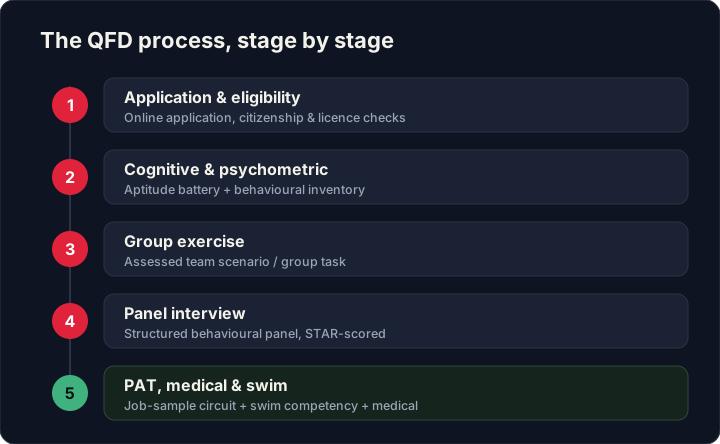
2027 campaign for 2027/28 courses: applications May–June 2026; beep July; online August–October; OFAT November; panel January 2027; psychology February; final checks March–April. Dates remain provisional. source review overdue (review due 2026-10-08); confirm the current candidate information pack.
Keep provisional milestones distinct from confirmed appointments. The campaign planning guide explains how to turn the timetable into a practical preparation plan; the QFD service page and Queensland overview provide further context.
Application and eligibility
Applicants must be Australian/New Zealand citizens or have permanent residence status. source review overdue (review due 2026-10-07); confirm the current candidate information pack. Year 12 or a QFD-recognised equivalent is required. source review overdue (review due 2026-10-07); confirm the current candidate information pack. At least two years of full-time-equivalent general paid work experience is required. source review overdue (review due 2026-10-07); confirm the current candidate information pack.
Check the evidence behind each requirement rather than relying on a broad sense that your background should qualify.
Mandatory list specifies manual C held one year or manual MR; the same pack also mentions minimum P2. Seek campaign-specific clarification. source review overdue (review due 2026-10-08); confirm the current candidate information pack.
If those instructions leave your eligibility unclear, ask recruitment about your licence and retain the response with your checklist.
Create Nexus profile/resume; recruit applicants leave non-mandatory suitability statement blank. source review overdue (review due 2026-10-08); confirm the current candidate information pack. Candidates must be eligible for a working-with-children Blue Card and provide a current paid card during selection. source review overdue (review due 2026-10-07); confirm the current candidate information pack.
FirePrep recommends checking your resume, document names and contact details before submission. Follow the form rather than drafting speculative answers for a field you have not been asked to complete.
Beep test
beep test level: ≥ 9.6 level — Complete level 9.6 in the pass/fail beep test. Higher completion levels do not add merit. source review overdue (review due 2026-10-07); confirm the current candidate information pack.
Build repeatable fitness through progressive training and recovery. FirePrep’s recommendation to develop a comfortable training margin is not an additional official benchmark or a promise of more merit.
Pack permits a second beep attempt within campaign if first result reaches 8.0; webpage blanket reattempt wording conflicts. source review overdue (review due 2026-10-08); confirm the current candidate information pack.
Clarify the campaign instruction before depending on another attempt. The beep-test comparison guide can help organise cross-service plans, but another agency’s warning rules are not QFD rules.
Cognitive assessment
Proctored mechanical/core abilities: literacy, numeracy, problem solving; no personal calculator, paper or phone. source review overdue (review due 2026-10-08); confirm the current candidate information pack.
Prepare by reviewing mistakes as well as timing yourself. If you lack a concept, work on it directly; if you rush instructions, change your reading routine. FirePrep recommends using varied practice rather than repeatedly memorising the same questions.
Follow the permitted-material rules in your assessment instructions. Do not assume a practice site’s tools will be available during the live assessment.
Operational Focused Abilities Test
Candidates undertake QFD’s Operational Focused Abilities Test under its published task protocol. source review overdue (review due 2026-10-07); confirm the current candidate information pack. ofat part one seconds: < 250 seconds — Cutter task: under 250 seconds. source review overdue (review due 2026-10-08); confirm the current candidate information pack.
ofat part two seconds: < 515 seconds — Six-station circuit: under 515 seconds. source review overdue (review due 2026-10-08); confirm the current candidate information pack. ofat part three seconds: < 204 seconds — Hose-reel task: under 204 seconds. source review overdue (review due 2026-10-08); confirm the current candidate information pack.
Those time limits are not the full protocol. Equipment, technique and recovery conditions matter:
Part two: 20kg vest, helmet, gloves and harness; stairs add two 6kg shoulder weights. source review overdue (review due 2026-10-08); confirm the current candidate information pack. Two-minute recovery after each allocated part-one/part-two period; early finish adds recovery. source review overdue (review due 2026-10-08); confirm the current candidate information pack. No running; falls/dropped equipment fail; repeated warnings can fail. source review overdue (review due 2026-10-08); confirm the current candidate information pack.
The QFD campaign guide connects the published task instructions with preparation advice. Use it to understand the demands, not to replace official demonstrations or supervision.
Pack permits a second OFAT attempt within assessment period; webpage blanket reattempt wording conflicts. source review overdue (review due 2026-10-08); confirm the current candidate information pack.
Read any retesting conditions in full and confirm your own assessment arrangements. Prepare for the published OFAT rather than adding an unconfirmed swimming requirement or substituting a generic gym test.
Panel interview
Panel usually 30–45 minutes; behavioural examples; notes allowed during perusal, not interview. source review overdue (review due 2026-10-08); confirm the current candidate information pack.
FirePrep recommends a bank of real examples you can explain flexibly. Use situation, task, action and result to keep the account clear, then practise answering questions about your judgement and learning.
Do not assume a particular number of stories or a memorised answer guarantees a score. Clear ownership and truthful detail are better preparation than trying to predict the exact questions.
Psychological assessment and final checks
Online plus Brisbane group/individual psychology; results valid 12 months; adverse profile may exclude campaigns during validity. source review overdue (review due 2026-10-08); confirm the current candidate information pack.
Answer honestly and follow the instructions. This published psychology component should not be turned into an unsupported claim about a separately ranked group exercise.
At least two current/past employer referees; QFD initiates criminal/integrity checks. source review overdue (review due 2026-10-08); confirm the current candidate information pack. Full medical before course, applicant-funded; medical advisor assesses individual circumstances. source review overdue (review due 2026-10-08); confirm the current candidate information pack.
Keep contact details current, disclose accurately and organise the records requested by the medical advisor. FirePrep cannot determine medical suitability from a diagnosis or an account of another candidate’s result.
Before recruit training
Before recruit training, evidence of current first aid, advanced resuscitation and a manual MR licence is required. QFD advises waiting for its request before completing time-sensitive qualifications. source review overdue (review due 2026-10-07); confirm the current candidate information pack. Sixteen-week recruit program; all pre-employment requirements must be satisfied. source review overdue (review due 2026-10-08); confirm the current candidate information pack.
Keep the timing advice attached to the qualifications. Booking everything immediately can be as unhelpful as leaving a required item too late.
Twelve-month probation starts at recruit-course commencement. source review overdue (review due 2026-10-08); confirm the current candidate information pack. Four-year minimum first-location tenure after graduation; transfer eligibility does not guarantee transfer. source review overdue (review due 2026-10-08); confirm the current candidate information pack.
Think through the household and financial implications of the confirmed offer rather than relying on an assumed transfer.
Where to put your preparation
Work on your actual limiting area while maintaining the others: document readiness, reasoning accuracy, physical capacity and clear behavioural evidence. FirePrep’s readiness check can help choose that next priority, but it is coaching guidance rather than a QFD selection decision.