South Australian Metropolitan Fire Service preparation should not depend on a guessed cohort size or an invented merit-list weighting. The more useful approach is to connect the actual application requirements to a sustainable plan for reasoning, communication and physical assessment.
This guide covers the career-entry pathway. Current service requirements appear alongside FirePrep preparation advice, which is not an official scoring system. Use the SAMFS service page and South Australia overview for further planning, and your current invitation for attendance arrangements.
Start with timing and eligibility
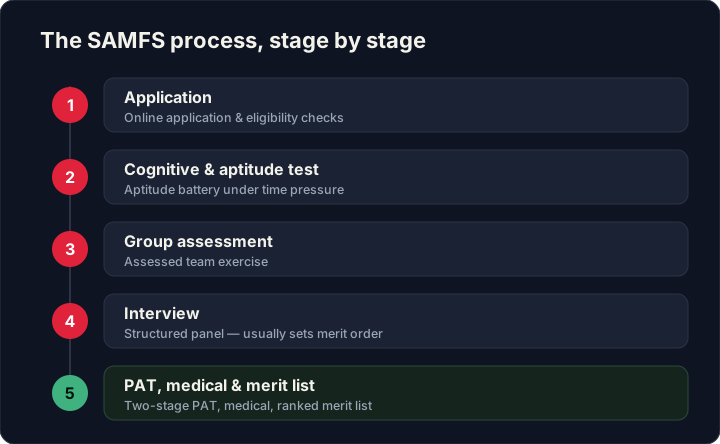
Full-time firefighter applications are closed. source review overdue (review due 2026-10-08); confirm the current candidate information pack. Recruitment is operationally scheduled; application-to-offer may take 5–18 months. source review overdue (review due 2026-10-08); confirm the current candidate information pack.
Do not turn an operationally scheduled process into a fixed annual calendar. FirePrep recommends keeping preparation sustainable and checking the current vacancy rather than expecting a particular cohort or opening month.
Applicants must be Australian citizens, permanent residents, or New Zealand citizens who entered Australia on a valid passport. source review overdue (review due 2026-10-07); confirm the current candidate information pack. Adult applicants need full C licence; learner/provisional licences are ineligible. source review overdue (review due 2026-10-08); confirm the current candidate information pack.
Licence stages need to be kept distinct. An MR licence must be obtained before employment; it is not required at application. source review overdue (review due 2026-10-07); confirm the current candidate information pack. Current HLTAID011 first aid must be obtained before employment; it is not required at application. source review overdue (review due 2026-10-07); confirm the current candidate information pack.
Make a checklist that separates what you need now from what you need before employment. That avoids both unnecessary early spending and late discovery of a missing requirement.
Build the application evidence
Apply with resume, declaration, ten-year driving history, tattoo images, two ≤150-word answers. source review overdue (review due 2026-10-08); confirm the current candidate information pack.
FirePrep recommends drafting concise examples before opening the form. Describe the situation briefly, explain your own actions and give an honest result. Check that the evidence and declarations match rather than trying to compensate for a missing document with a longer answer.
Visible tattoos must satisfy MFS dress policy. source review overdue (review due 2026-10-08); confirm the current candidate information pack. Criminal screening is case-specific; certain convictions in the preceding five years prevent progression. source review overdue (review due 2026-10-08); confirm the current candidate information pack.
These are service requirements, not an invitation to guess how an individual case will be decided. Where a policy question affects you, ask recruitment what information is required and disclose accurately.
Aptitude and psychometric preparation
Online aptitude/psychometric testing includes verbal and written communication, problem solving, mechanical reasoning and decisions with incomplete information. source review overdue (review due 2026-10-07); confirm the current candidate information pack.
FirePrep recommends broad diagnostic practice followed by targeted work. Separate a knowledge gap from a misread question or a pacing problem: each needs a different response. For incomplete-information exercises, identify what is known, what is uncertain and what conclusion the evidence actually permits.
Review your reasoning, not just your score. A practice-provider result is not an official MFS cut score, and an official pass mark is not confirmed here. Answer self-report questions honestly rather than trying to construct a supposedly ideal profile.
Group assessment and interview
Candidates attend an in-person group assessment centre. source review overdue (review due 2026-10-07); confirm the current candidate information pack.
FirePrep’s group-work advice is to listen, clarify the objective and contribute something useful. Practise explaining an idea without dominating, and changing your view when someone supplies better information. These are transferable communication habits, not claims about hidden marking weights.
The in-person interview uses a three-person panel with behavioural and situational questions. source review overdue (review due 2026-10-07); confirm the current candidate information pack.
Build examples around genuine experience. A situation–task–action–result structure can keep an answer clear, but rehearse follow-up questions so it does not become a speech. Be ready to explain what you learned and what you would do differently.
Do not assume interview performance alone sets merit order or that a particular cohort size makes one stage decisive; neither is confirmed here. Allocate practice according to your own gaps rather than those assumptions.
The physical assessments
The shuttle benchmark needs its movement rules as well. Touch/cross each 20m line; do not leave before beep. Four yellow cards terminate PAT1. source review overdue (review due 2026-10-08); confirm the current candidate information pack. FirePrep recommends controlled turns and pacing practice alongside gradual aerobic development, rather than treating every training session as an all-out test.
For the functional component, PAT2 sequence: ladder/hose, tunnel, casualty, ceiling, ladder handling, tower, haul, entry, hose, equipment, encapsulated suit. source review overdue (review due 2026-10-08); confirm the current candidate information pack. PAT2 runs at Adelaide Fire Station. source review overdue (review due 2026-10-08); confirm the current candidate information pack.
A total time is not the whole protocol. Earlier events must finish within 27 minutes. Clock pauses for suit fitting; then two minutes standing, followed by checkerboard container stacking within three minutes. One drum per carry; incorrect pattern, drops, voluntary stop or repeated same-action warning fails. source review overdue (review due 2026-10-08); confirm the current candidate information pack. Read this with the earlier events, not as a stand-alone description of the complete assessment.
FirePrep recommends progressive pulling, carrying, lower-body strength and recovery work. Grip endurance can be a useful training focus, but it is not established here as the most common cause of failure. The MFS PAT guide explains the event instructions and training implications in more detail.
Medical, screening and references
MFS pays occupational medical/audiology and required follow-up assessment costs. source review overdue (review due 2026-10-08); confirm the current candidate information pack. Unaided better-ear average hearing threshold must be 40dB or better at 500/1000/2000/3000Hz. source review overdue (review due 2026-10-08); confirm the current candidate information pack.
The hearing fact is a specific published requirement, not a complete medical clearance checklist. Ask the relevant medical contact about individual circumstances rather than interpreting a practice fitness result as proof of occupational suitability.
SAFECOM police/WWCC checks; two work referees, normally current/previous managers. source review overdue (review due 2026-10-08); confirm the current candidate information pack.
FirePrep recommends checking referee contact details and asking permission before supplying them. Keep your work history accurate and be ready to provide requested records. Do not invent favourable treatment for disclosure; provide the information honestly because the process requires accurate evidence.
Recruit training and posting decisions
Paid approximately 16-week course: Angle Park/Adelaide; two-day Brukunga residential component. source review overdue (review due 2026-10-08); confirm the current candidate information pack. Twelve-month probation starts with recruit employment. source review overdue (review due 2026-10-08); confirm the current candidate information pack.
Think about the transition from preparation to learning. FirePrep recommends maintaining study habits, practising receiving feedback and discussing household commitments before making decisions about an offer.
Metropolitan graduates initially relieve across stations; Port Pirie/Mount Gambier offers are possible; preferences are not guaranteed. source review overdue (review due 2026-10-08); confirm the current candidate information pack.
Preferences and promises are not interchangeable. Confirm the actual location and attendance arrangements before committing to accommodation or assuming the most convenient posting.
Keep the plan balanced
No limit on campaign applications or minimum reapplication interval. source review overdue (review due 2026-10-08); confirm the current candidate information pack.
Reapplication guidance does not change the physical attempt policy shown above. Use feedback, where available, to improve your next plan rather than assuming a live assessment is a practice opportunity.
Keep evidence preparation, cognitive work, communication and physical training moving together. The FirePrep readiness check can help identify your next coaching priority, but it cannot assign an official merit position, clear a medical requirement or guarantee employment.