Tasmania Fire Service preparation is easier to organise when you separate confirmed requirements from stories about small intakes, interview weightings and waiting periods. The useful questions are practical: what evidence do you need, what assessments should you prepare for and what must be resolved before training?
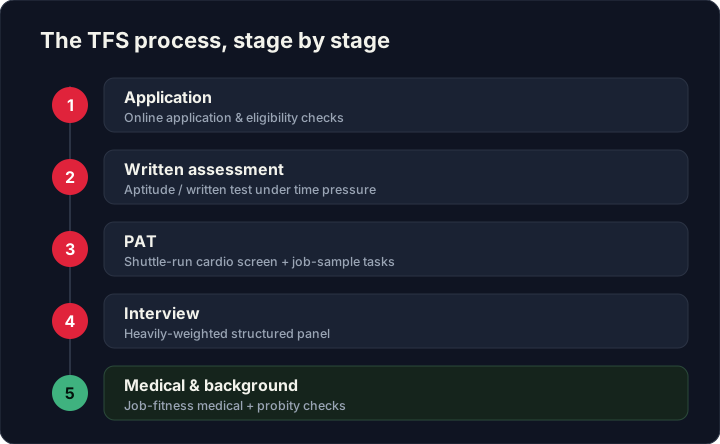
This guide maps those topics without inventing a fixed stage count. Official career facts are kept distinct from FirePrep preparation advice. Use the TFS service page, Tasmania recruitment overview and the current campaign instructions alongside it.
Application timing and eligibility
Next campaign is being planned; application and assessment dates are not confirmed. source review overdue (review due 2026-10-08); confirm the current candidate information pack.
Do not turn planning language into a confirmed opening date or an assumed course year. FirePrep recommends maintaining a flexible preparation routine and checking the actual vacancy before booking around a campaign.
Applicants need Australian citizenship/permanent residency, New Zealand citizenship, or a current visa permitting work in Australia. source review overdue (review due 2026-10-07); confirm the current candidate information pack. No formal qualifications are required to apply for the entry-level firefighter role. source review overdue (review due 2026-10-07); confirm the current candidate information pack.
Driving requirements need particular care. Appointment requires an unrestricted full manual C licence. The FAQ permits provisional applicants if they obtain it by the employment-offer stage. source review overdue (review due 2026-10-07); confirm the current candidate information pack. Read the qualification and deadline together. If official instructions leave your eligibility unclear, ask recruitment before deciding whether to apply.
Be eligible for MR licensing by recruit-course commencement; holding MR initially is desirable. source review overdue (review due 2026-10-08); confirm the current candidate information pack.
Application, offer and course commencement are different reference points. FirePrep recommends a checklist that records both the evidence and the stage at which it is needed.
The written application
Submit selection-criteria statement, CV, two referees and licence details. source review overdue (review due 2026-10-08); confirm the current candidate information pack.
Read the live selection criteria rather than copying an old list from a blog. FirePrep recommends choosing specific examples, explaining your own actions and making the outcome clear. A concise, well-supported example is more useful than a long declaration that you possess every desirable quality.
Check that the work history, licence details and referee information are consistent. Save the application you actually submitted so later preparation is grounded in your own evidence rather than a half-remembered draft.
Shuttle run preparation
beep test level: ≥ 9.6 level — Reach level 9.6 in TFS’s shuttle-run assessment. source review overdue (review due 2026-10-07); confirm the current candidate information pack.
FirePrep recommends building aerobic capacity progressively while practising controlled turns and pacing. A practice score is a preparation measure, not a substitute for the assessment. Do not assume another service’s warning rules or a generic fitness-test app supplies the complete TFS protocol.
The TFS shuttle and physical-preparation guide explains how to connect running with the other physical demands, without relying on an unconfirmed waiting-period rule.
Cognitive and psychometric assessment
Cognify assesses verbal/numerical reasoning and problem solving; SafeSelect screens psychological risk. source review overdue (review due 2026-10-08); confirm the current candidate information pack.
FirePrep recommends diagnosing your reasoning gaps, then combining untimed learning with timed practice. Check why an answer was wrong: misreading, an unfamiliar method and rushing call for different fixes.
Answer self-report questions honestly rather than rehearsing an idealised personality. A universal assessment reuse interval or reapplication waiting period is not confirmed here. If you have a previous result, ask recruitment how it applies to the current campaign.
Physical abilities: more than a running result
The sequence and clearance requirement matter alongside the individual times. For example, road crash rescue seconds: ≤ 105 seconds — Complete the three road-crash-rescue tool tasks and return the tool to the ground within 105 seconds. source review overdue (review due 2026-10-07); confirm the current candidate information pack. Alternate three 15-second unsupported holds with three 20-second vehicle-contact holds; ground tool only at end. Second offence, drop/incomplete task fails. source review overdue (review due 2026-10-08); confirm the current candidate information pack.
FirePrep recommends learning the handling instructions before adding speed or load to preparation. The confined-space component has its own conditions: Darkened confined-space navigation with BA/facemask, instructions and questions; mask removal or inability to finish fails. source review overdue (review due 2026-10-08); confirm the current candidate information pack. Do not improvise reduced-visibility or confined-space testing alone.
For another example of a compound task, tower climb seconds: ≤ 96 seconds — Complete the tower climb and container haul within 96 seconds under the published task instructions. source review overdue (review due 2026-10-07); confirm the current candidate information pack. Climb to 15m platform; haul 15kg up 8m hand-over-hand, over rail and 1m down onto platform; identify two ground symbols, then descend. source review overdue (review due 2026-10-08); confirm the current candidate information pack.
A time or load extracted from that instruction would not describe the whole task. Use the physical-preparation guide for the remaining task guidance, and keep higher-risk familiarisation in an appropriate supervised setting.
Interview and referee preparation
Interview assesses selection criteria and considers psychological assessment results. source review overdue (review due 2026-10-08); confirm the current candidate information pack.
An interview weighting relative to other services is not confirmed here. FirePrep still recommends meaningful rehearsal: choose genuine examples, explain your decisions and practise responding to follow-up questions. STAR can organise your answer without becoming a rigid script.
Normally current/recent manager from preceding three–six months; discuss alternate referees if unavailable. source review overdue (review due 2026-10-08); confirm the current candidate information pack.
Ask permission before supplying a referee and check their contact information. Where the normal arrangement does not fit your circumstances, seek recruitment guidance rather than quietly substituting someone unsuitable.
Medical and pre-employment checks
Role-specific medical assessment determines individual suitability. source review overdue (review due 2026-10-08); confirm the current candidate information pack. Pre-employment conviction checks assess relevance and risk individually. source review overdue (review due 2026-10-08); confirm the current candidate information pack.
Do not infer a medical clearance or an automatic exclusion from a generic checklist. Provide requested information accurately and ask the relevant contact what evidence is needed. Clearance for physical testing, described above, is distinct from occupational suitability for employment.
Recruit training and development
Fifteen-week recruit course based at Cambridge, with northern training components. source review overdue (review due 2026-10-08); confirm the current candidate information pack. Six-month probation leads to permanent employment. source review overdue (review due 2026-10-08); confirm the current candidate information pack.
Confirm when probation begins in your employment documents; do not infer its start point from a duration alone.
Four-year development towards Senior Firefighter. source review overdue (review due 2026-10-08); confirm the current candidate information pack.
FirePrep recommends planning for learning as well as assessment: sustainable study, receiving feedback and practical household arrangements. Do not convert a development pathway into a promise of promotion or a particular posting.
Where to put your preparation
Balance the application, reasoning, physical and communication work according to your own gaps. Do not delay or rush solely because an old article claimed a universal waiting period, and do not assume a practice result predicts a place.
The FirePrep readiness check can help organise your next steps. It is a coaching tool, not an official ranking, employment clearance or guarantee of selection.