If you are searching for “CFA recruitment”, begin by clarifying the role you want. This guide concerns a volunteer enquiry, not a career application or a guaranteed route to an operational role. Knowing that distinction helps you ask useful questions instead of preparing for a test that may not apply to you.
CFA volunteer requirements need their own confirmation: an age limit, licence rule, background-check policy, fitness standard, probation period or training timetable cannot be inferred from career recruitment guidance. Rather than substituting FRV career rules, this guide shows how to resolve your questions with the appropriate CFA contact.
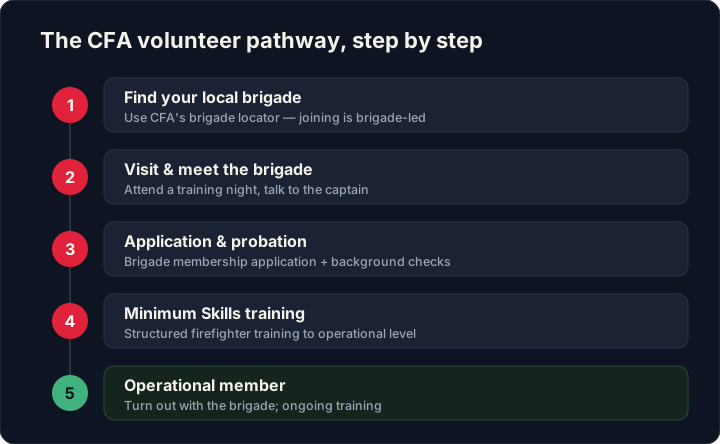
The pathway, and where to go deep
The following is FirePrep’s suggested enquiry order, not an official CFA stage diagram:
Clarify your goal → find the official contact → discuss the role → confirm the application instructions → understand training and ongoing commitment.
This is an enquiry checklist. It does not certify eligibility or permission to attend incidents.
Use the CFA service page and Victorian overview for orientation. The CFA volunteer pathway article goes deeper into deciding whether the commitment suits your life.
Start with the role, not a presumed test
Write down why you want to volunteer and what you can realistically offer. Consider where you live and work, your existing responsibilities and the activities you are interested in learning about. That gives your first conversation a practical starting point.
Do not assume that enthusiasm settles suitability or that every opportunity involves the same activities. Ask what roles are available and what the expectations are for the role you are considering. This article cannot promise a particular option.
Find the appropriate local contact
Use CFA’s official website or enquiry channel to identify whom to contact. Ask whether there is an information session or another suitable way to learn about the opportunity. Do not arrive at training expecting to participate without an invitation.
Prepare a short introduction: your interest, general location and availability, followed by your questions. You do not need an emergency-service vocabulary to have a useful conversation. Listening carefully and being honest about your constraints is more helpful than trying to sound experienced.
Discuss availability before making promises
Training frequency, response expectations and joining timelines need direct confirmation for CFA volunteers. Ask about those points and whether expectations differ by role.
Useful prompts include:
- What does regular participation look like for this opportunity?
- How are work, study and caring commitments discussed?
- What happens if my availability changes?
- Which activities would need additional training or approval?
Take the answers home and discuss them with anyone affected by your commitment. Avoid promising availability you cannot sustain simply to make a good first impression.
Confirm application and checking instructions
CFA volunteer identity, background and health requirements cannot be inferred from career guidance. Ask for the current instructions and the correct submission route before sending documents. A requirement listed for FRV is not evidence that CFA requires the same document, deadline or assessment.
FirePrep recommends keeping an application log: what you were asked to provide, when you submitted it and any clarification still outstanding. Declare information accurately and ask how to correct an error rather than guessing what a question means.
Understand training before expecting operational participation
A CFA course name, qualification sequence or time to operational participation is not confirmed here. Ask what learning and assessment apply, how they are scheduled and who confirms readiness for particular activities.
Treat training as learning, not as a box to tick. Record questions, seek feedback and be candid when you do not understand an instruction. Never practise unfamiliar emergency tasks, work at height or restricted-visibility drills without appropriate supervision.
If your actual goal is a career role
Use the FRV recruitment guide as a separate career starting point. FRV’s current written assessment is: ACER literacy, numeracy, abstract/mechanical reasoning; pass every subtest and meet ranking requirement. source review overdue (review due 2026-10-08); confirm the current candidate information pack. Its group assessment is: Group activities test written/verbal communication, teamwork and practical problem solving. source review overdue (review due 2026-10-08); confirm the current candidate information pack.
Training and posting also deserve attention. Approximately 20 weeks at Craigieburn; pass practical and theory assessments. source review overdue (review due 2026-10-08); confirm the current candidate information pack. Graduates can be assigned to FRV stations throughout Victoria. source review overdue (review due 2026-10-08); confirm the current candidate information pack. These statements apply to FRV career recruitment only; they do not describe CFA volunteer training or deployment.
Volunteer experiences may give you useful material to reflect on, but do not assume an exemption, preference or shortened career course. Ask the recruiting service about any recognition you believe may apply.
Where to put your effort
For volunteering, your best next action is an informed enquiry and an honest discussion of commitment. For career preparation, it is a service-specific eligibility check and a realistic study and fitness plan. Keeping those actions separate prevents a misleading “one pathway fits all” approach.
The readiness check can help organise career preparation. It is not a CFA membership assessment, medical clearance or authorisation to participate in operational activities.