Fire Rescue Victoria preparation is not just a choice between studying and getting fit. The useful question is how to build a plan that covers eligibility evidence, written performance, group work, interview examples and task-specific physical skills. This guide maps those areas without claiming an unsupported stage count or predicting where applicants are most often eliminated.
Official requirements are drawn from the current career facts; FirePrep recommendations are preparation advice, not additional gates. Use the FRV service page and Victorian recruitment overview alongside your campaign instructions.
How the assessments contribute
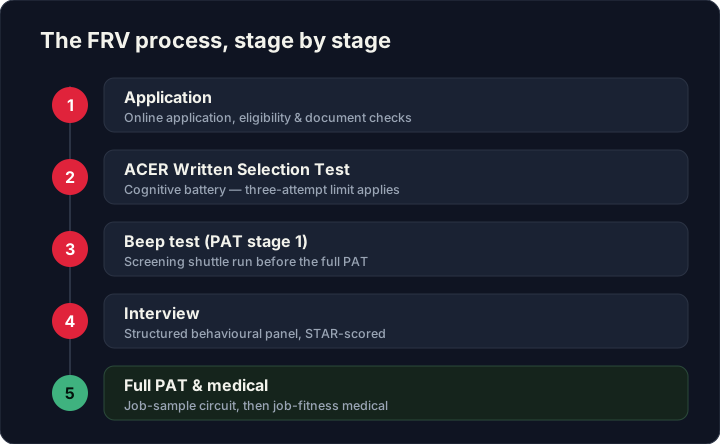
Keep these distinctions intact. A ranking contribution, a task requirement and a reattempt policy answer different questions. FirePrep recommends preparing broadly while putting extra practice into the area where your own evidence shows a weakness, rather than assuming an unsupported national failure-rate statistic applies to you.
Application and eligibility
Applicants must be Australian citizens, permanent residents, or New Zealand citizens who entered Australia on a valid passport. source review overdue (review due 2026-10-07); confirm the current candidate information pack.
Licence timing is campaign-specific, so do not rewrite it as a rule for every future recruit year. For the published campaign, applicants must have held a driver licence for two years by 1 January 2027, excluding learner periods; green probationary licences are accepted. source review overdue (review due 2026-10-07); confirm the current candidate information pack. Eight or more driving demerits at application or before an employment offer disqualify an applicant. source review overdue (review due 2026-10-07); confirm the current candidate information pack.
Applicants undergo a nationally coordinated criminal history check and must satisfy FRV’s criminal and driving history policies. source review overdue (review due 2026-10-07); confirm the current candidate information pack.
FirePrep recommends checking your driving history and documents before investing in bookings. If your circumstances are not straightforward, ask recruitment how to provide the evidence; do not assume a general fitness result answers an eligibility question.
The published campaign window is: Campaign applications ran 4–17 May 2026, midday deadlines, for 2027/2028 recruit courses. source review overdue (review due 2026-10-08); confirm the current candidate information pack. Treat this as campaign information, not a forecast of the next opening. Keep the current vacancy and your actual invitations together so you are not working from an old calendar.
The Written Selection Test
ACER literacy, numeracy, abstract/mechanical reasoning; pass every subtest and meet ranking requirement. source review overdue (review due 2026-10-08); confirm the current candidate information pack. Use the supplied on-screen calculator; personal calculators are not allowed. source review overdue (review due 2026-10-08); confirm the current candidate information pack.
Build an error log across the stated domains. In numeracy, identify whether the problem was calculation, interpretation or time management. In mechanical and abstract work, explain the principle or pattern before checking the answer. FirePrep recommends timed practice only after you have a usable method to practise.
Written-selection-test results remain valid for three years. source review overdue (review due 2026-10-08); confirm the current candidate information pack.
A lifetime attempt cap is not confirmed here. Do not turn result validity into a ban on future applications or a promise of a re-sit. The FRV Written Selection Test guide explains preparation and questions to clarify about previous attempts. The FRV aptitude guide offers further study guidance.
Group work, profile and interview
Group activities test written/verbal communication, teamwork and practical problem solving. source review overdue (review due 2026-10-08); confirm the current candidate information pack.
FirePrep recommends practising how to clarify a task, contribute a workable idea and listen to alternatives. Aim for useful participation, not a performance of leadership that crowds out the group.
Untimed supervised work-preference questionnaire informs interview; it is not pass/fail. source review overdue (review due 2026-10-08); confirm the current candidate information pack. Approximately 45-minute selection interview includes general and behavioural questions. source review overdue (review due 2026-10-08); confirm the current candidate information pack.
Answer self-report questions honestly. For interview preparation, develop genuine examples and practise follow-up questions about your actions, judgement and learning. Use STAR as an organising tool, not as a memorised script or a claim about the service’s scoring method.
Shuttle run and the PAT
beep test level: ≥ 9.6 level — Reach level 9.6 in FRV’s 20-metre shuttle run. source review overdue (review due 2026-10-07); confirm the current candidate information pack.
FirePrep recommends progressive aerobic training and practice turning to the assessment rhythm. A training margin can reduce reliance on a personal-best effort, but it is not extra merit unless a published rule says so.
The task protocols make clear why physical preparation should extend beyond running. For example, Haul 15kg container hand-over-hand onto second-floor balcony; head/hands outside for visibility; carry pack upstairs to fifth floor using every step/handrail. source review overdue (review due 2026-10-08); confirm the current candidate information pack.
That is a reason to develop controlled pulling and stair-carry capacity, not to treat a gym load as a stand-alone official pass mark.
Drag hose 20m, return 10m, drag again; turn 45 degrees, advance 10m, pull 10m into box. The former 70-second limit is removed. source review overdue (review due 2026-10-08); confirm the current candidate information pack.
Use the current hose instructions rather than an old circuit diagram. For sustained hose work and casualty handling, the relevant guidance is:
Advance charged 50mm hose 5m, then follow targeting instructions for two minutes. source review overdue (review due 2026-10-08); confirm the current candidate information pack. Lift 72kg casualty to chest height; drag backwards 45m including ramp. Readjusting grip is allowed without losing contact. source review overdue (review due 2026-10-08); confirm the current candidate information pack.
FirePrep recommends qualified supervision for unfamiliar equipment work and progressive strength training at manageable loads. Do not improvise hazardous ladder or pressurised-hose assessments. FRV permits a second shuttle-run attempt and a second PAT attempt. source review overdue (review due 2026-10-08); confirm the current candidate information pack. Ask recruitment about scheduling rather than assuming a reattempt can occur whenever you choose.
Medical evidence and employment preparation
Pre-employment medical includes drug testing; individual assessment determines suitability. source review overdue (review due 2026-10-08); confirm the current candidate information pack.
Check evidence requirements early enough to ask a clinician about your records. Required evidence: hepatitis A/B, MMR and diphtheria/tetanus/pertussis; latter within ten years. Varicella is recommended. source review overdue (review due 2026-10-08); confirm the current candidate information pack. Hepatitis B/MMR immunity testing and indicated boosters are required; incomplete evidence can jeopardise offer. source review overdue (review due 2026-10-08); confirm the current candidate information pack.
This is not a diagnosis-based eligibility tool. Follow the medical process for individual questions rather than assuming every issue is either correctable or disqualifying.
Obtain HR licence after an employment offer, under offer instructions. source review overdue (review due 2026-10-08); confirm the current candidate information pack. Approximately 20 weeks at Craigieburn; pass practical and theory assessments. source review overdue (review due 2026-10-08); confirm the current candidate information pack. Graduates can be assigned to FRV stations throughout Victoria. source review overdue (review due 2026-10-08); confirm the current candidate information pack.
FirePrep recommends discussing practical travel and household commitments before accepting an offer, while confirming actual arrangements through the service.
Where to put your preparation
Maintain written practice, physical development and interview examples in parallel. Review your own weak points regularly, and leave room for recovery rather than cramming each component when an invitation arrives.
If you are exploring volunteering, the CFA pathway hub is a separate starting point. FRV career guidance does not establish CFA eligibility, exemptions or training conditions. Ask CFA about that pathway directly.
The FirePrep readiness check can help organise your preparation priorities. It is a coaching tool, not an official merit score or a prediction of employment.