Interview preparation is not about guessing a secret question bank. It is about becoming better at explaining what you have done, why you made a decision and what you learned. A carefully chosen example gives a listener something concrete to assess; a slogan about being a great teammate does not.
The confirmed career assessment context is broader than an isolated panel conversation: Online work styles followed by Greenacre group activities, scenarios and interview. source review overdue (review due 2026-10-08); confirm the current candidate information pack. Prepare to communicate with other people as well as to talk about yourself.
This article’s question themes, STAR structure and rehearsal suggestions are FirePrep coaching recommendations. Exact interview questions, panel composition, scoring weights and a formula for merit-list placement are not confirmed here. Use your invitation for assessment instructions.
Understand the assessment context
Keep the recorded interview distinct from the assessment-centre context. Cognitive, emotional-intelligence and mechanical-reasoning tests plus recorded video interview; online proctoring. source review overdue (review due 2026-10-08); confirm the current candidate information pack.
The online assessment guide covers preparation for that setting. The underlying communication skill transfers: answer the question you were asked, use evidence and make your personal contribution understandable. The format, timing and permitted materials should come from the relevant invitation, not assumptions carried over from another assessment.
For collaborative practice, rehearse listening, summarising another person’s idea and contributing without dominating. A useful exercise is to discuss a simple planning problem with a friend, then ask whether you helped the discussion become clearer. That is a FirePrep practice exercise, not a reconstruction of an official scenario.
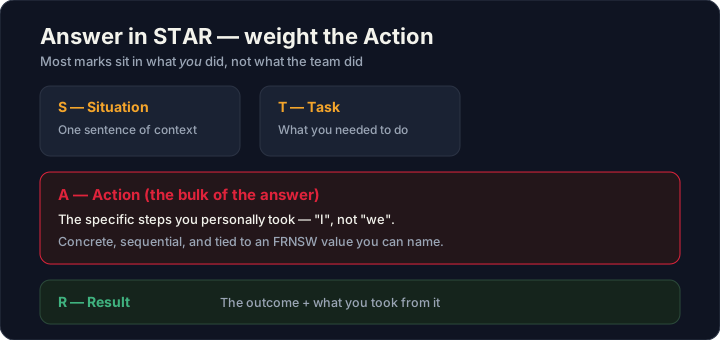
STAR—and why the Action deserves space
STAR means Situation, Task, Action and Result. It is an organising tool, not a script or an official marking allocation.
Situation: What was happening? → Task: What were you responsible for? → Action: What did you do and why? → Result: What changed, and what did you learn?
Keep the background brief enough that the listener can follow the problem. Then spend useful time on your decisions and actions. “We sorted it out” leaves your role unclear. “I checked the conflicting instructions, spoke with the supervisor and explained the revised plan to the team” gives a much clearer account.
Do not erase the team’s contribution to make yourself sound stronger. Explain what you personally did, where you sought help and how other people contributed. Close with an honest outcome; if it was imperfect, explain the lesson rather than inventing a success.
Be specific without manufacturing a story
Compare “I include everyone” with a concrete account of noticing a quieter colleague, inviting their view and adapting a discussion after listening to them. The latter makes behaviour visible.
That example is illustrative, not something to copy into your own answer. Use a situation that actually happened to you. Do not add impressive numbers, invented responsibilities or a dramatic result just because a practice answer sounds better with them.
When linking an example to the role, explain the relevant behaviour: care with instructions, respectful communication, willingness to learn or a considered response to uncertainty. Research current role material rather than reciting an assumed list of official values.
Build a story bank that flexes
FirePrep suggests gathering several rich examples rather than writing a separate speech for every possible question. Useful practice themes include:
- A disagreement you handled constructively.
- A mistake you acknowledged and corrected.
- A difficult skill you learned with feedback.
- A time you supported someone without taking over.
- A decision made when information was incomplete.
- Service to a customer, colleague or community.
These are preparation prompts, not reported FRNSW questions. For each, note the context, your responsibility, the choices available, your actions and the outcome. Then practise answering different prompts from the same experience without forcing an irrelevant story into the question.
Make your evidence consistent with your application
You do not need to invent operational experience to sound credible. Previous firefighting experience is not required; recruit training is provided. source review overdue (review due 2026-10-07); confirm the current candidate information pack. Think carefully about the transferable evidence in your actual work, study and other responsibilities.
References deserve preparation too. Provide managers from the past three years where possible; volunteer/self-employed alternatives require recruitment guidance. source review overdue (review due 2026-10-08); confirm the current candidate information pack. Check contact details, ask permission and remind prospective referees of work you genuinely did together. Do not coach them to repeat an embellished version of your experience.
The on-call reference within career eligibility must not be confused with on-call recruitment rules. HSC, Certificate III, trade, three years FRNSW on-call service, or recognised higher/equivalent qualification. source review overdue (review due 2026-10-08); confirm the current candidate information pack. This is a career qualification fact, not a separate retained/on-call entry guide.
Rehearse for clarity, not perfection
Record yourself and listen for long introductions, unexplained jargon and places where the action disappears behind “we”. Ask a practice partner what they understood you personally contributed. If they cannot tell, make the example clearer rather than louder or more dramatic.
Leave room to think. A natural pause can be more useful than rushing into a memorised answer. Follow the actual assessment instructions about timing and materials; this guide does not invent a universal answer duration.
The full recruitment guide connects interview preparation with the rest of the application. Use the FirePrep readiness check to identify practice priorities, while keeping coaching feedback distinct from an official FRNSW assessment or selection prediction.