Preparing for Fire and Rescue NSW is easier when you separate the questions. Are you eligible to apply? Which assessments need practice? What paperwork is due before attendance? What must be arranged before recruit training?
Those are related questions, but they do not all have the same deadline. This guide brings current published career guidance into a practical preparation map, with deeper articles for each major topic. It does not rank stages by invented failure rates or promise a fixed time from application to offer.
This is career recruit guidance. Retained/on-call and volunteer pathways need separate confirmation; do not use the eligibility or physical requirements below as their entry rules.
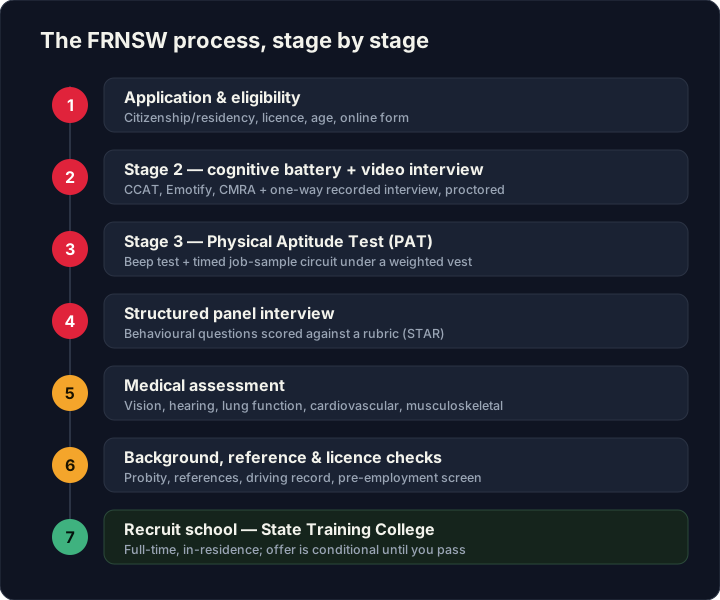
Start with the right campaign
2026 applications ran 9–20 March; these are historical dates. source review overdue (review due 2026-10-08); confirm the current candidate information pack.
That statement describes a historical window, not an upcoming opening. Save current candidate communications and check the FRNSW careers site for the opportunity you intend to pursue. Do not infer future dates from the month of an earlier campaign.
FirePrep recommends keeping an application folder with current instructions, supporting documents, submitted forms and correspondence. Record actual deadlines when they are supplied, including their purpose: an application deadline is not automatically the deadline for every later qualification.
Application eligibility: check each requirement separately
Work rights and qualifications
Eligible work rights include Australian citizenship, Australian permanent residency or New Zealand citizenship. source review overdue (review due 2026-10-07); confirm the current candidate information pack.
HSC, Certificate III, trade, three years FRNSW on-call service, or recognised higher/equivalent qualification. source review overdue (review due 2026-10-08); confirm the current candidate information pack.
Gather the evidence relevant to your own route through those requirements. If a qualification’s equivalence is unclear, ask recruitment rather than treating a similar title as automatic acceptance.
The on-call-service reference in the education fact is an option within career application eligibility. It does not establish the rules for entering on-call service.
Experience is a separate question: Previous firefighting experience is not required; recruit training is provided. source review overdue (review due 2026-10-07); confirm the current candidate information pack. Focus your application preparation on accurate evidence of what you have actually done, rather than manufacturing a firefighting background.
Driving eligibility now—and licensing later
Application minimum: green P2 or transferable Australian equivalent. source review overdue (review due 2026-10-08); confirm the current candidate information pack.
Application maximum: seven demerits on full licence, one on provisional licence. source review overdue (review due 2026-10-08); confirm the current candidate information pack.
Check your own documents and driving record rather than relying on memory. Then put the later obligation on a separate line in your plan: Obtain MR before recruit-course placement; applicant pays. source review overdue (review due 2026-10-08); confirm the current candidate information pack.
This separation helps you avoid both applying with an unmet application requirement and assuming a qualification needed later must already be held when you start the form. Ask recruitment about any age, first-aid or other eligibility question not answered here rather than borrowing another service’s rule.
The FRNSW service page and NSW overview provide surrounding pathway context.
Online assessments and the recorded interview
Cognitive, emotional-intelligence and mechanical-reasoning tests plus recorded video interview; online proctoring. source review overdue (review due 2026-10-08); confirm the current candidate information pack.
FirePrep recommends preparing reasoning skills and clear spoken examples alongside physical training. For reasoning practice, review errors carefully rather than measuring progress only by how many questions you completed. For recorded answers, practise explaining your personal actions without reading a script.
There is a campaign-specific change worth keeping qualified: The verification testing stage was removed for 2026. source review overdue (review due 2026-10-08); confirm the current candidate information pack. Do not turn that historical statement into a promise about every future campaign.
The cognitive and video-interview guide covers practical preparation and technical checks without guessing question counts, time limits or proctoring penalties.
Physical assessment: use the actual task descriptions
A doctor’s medical clearance must reach recruitment by the specified deadline before PAT attendance. source review overdue (review due 2026-10-07); confirm the current candidate information pack. Complete the requested clearance process rather than treating a training log as permission to attend.
Three-stage PAT wearing PPE/ankle weights; walking only; rests continue the clock. source review overdue (review due 2026-10-08); confirm the current candidate information pack.
- Untimed reduced-visibility and ladder-simulation tasks precede timed stages. source review overdue (review due 2026-10-08); confirm the current candidate information pack.
- Jerry-can carry/stairs, rescue-tool static hold and repeated hose drag; published guidance says generally under 15 minutes. source review overdue (review due 2026-10-08); confirm the current candidate information pack.
- Fire attack and rescue; published guidance says generally under two minutes, not an unconditional numeric cutoff. source review overdue (review due 2026-10-08); confirm the current candidate information pack.
Stage three starts only after the full stage-two 15-minute period; early finish provides recovery. source review overdue (review due 2026-10-08); confirm the current candidate information pack.
Pass the PAT on the first attempt. source review overdue (review due 2026-10-08); confirm the current candidate information pack.
The PAT minimums guide explains the supported descriptions and sensible training applications. How hard the PAT is discusses task-specific readiness. The beep-test guide explains why an unverified shuttle threshold should not be used as an FRNSW gate.
Assessment-centre preparation is broader than a speech
Online work styles followed by Greenacre group activities, scenarios and interview. source review overdue (review due 2026-10-08); confirm the current candidate information pack.
FirePrep recommends practising listening and contribution as well as individual answers. In a group practice exercise, aim to make the discussion clearer: ask a useful question, build on someone else’s point and explain your reasoning without taking over.
For personal examples, STAR can help organise your answer into situation, task, action and result. It is a coaching framework, not a published FRNSW marking formula. The interview guide shows how to build a flexible, truthful story bank.
Medical assessment: individual circumstances matter
Occupational physician assesses complete medical history individually; disclose previous and current conditions. source review overdue (review due 2026-10-08); confirm the current candidate information pack.
Medical screening includes pathology, ECG and spirometry; applicants bear assessment costs. source review overdue (review due 2026-10-08); confirm the current candidate information pack.
Do not infer a medical outcome from an isolated diagnosis, a fitness result or another candidate’s story. Organise your history and relevant records, follow appointment instructions and discuss concerns with the assessing provider or your treating clinician.
The medical guide distinguishes occupational assessment from PAT clearance and avoids unsupported condition-specific pass claims.
Employment checks and references
National police, driving and conduct checks; MR licensing required before course placement. source review overdue (review due 2026-10-08); confirm the current candidate information pack.
Provide managers from the past three years where possible; volunteer/self-employed alternatives require recruitment guidance. source review overdue (review due 2026-10-08); confirm the current candidate information pack.
There is useful preparation here beyond simply waiting. Check contact details, ask prospective referees for permission and keep declarations consistent with your records. If your work history does not fit the usual referee arrangement, seek the guidance described above rather than quietly substituting someone.
Do not coach a referee to exaggerate your role or guess how a background issue will be decided. Accuracy and prompt responses are within your control; an official decision is not.
Recruit training and practical commitments
Paid 13-week course; pass all subjects and arrange accommodation; graduates join operational platoons. source review overdue (review due 2026-10-08); confirm the current candidate information pack.
Read joining and employment instructions before making housing, work or family commitments. In particular, do not assume that a recruit course automatically includes residential accommodation.
The recruit-school guide covers maintaining fitness, learning habits, budgeting and being ready to receive feedback. It does not invent a timetable, syllabus sequence or preferred posting guarantee.
Where to put your preparation effort
Use evidence from your own preparation, not a claim that a particular stage “cuts the most people”. If reasoning errors are persistent, review the underlying method. If carrying technique deteriorates, seek appropriate coaching. If documents or licensing are unresolved, give those tasks real calendar space.
FirePrep recommends a balanced plan with physical work, reasoning practice, communication rehearsal and administration. Review it regularly and adjust it when current instructions arrive.
The FirePrep readiness check can help identify those preparation priorities. Coaching targets are not extra official gates, and a readiness result cannot replace recruitment, medical or assessment decisions.