Start your FRNSW physical preparation with the assessment you are actually expected to complete. A shuttle-run pass mark is not confirmed here, so this guide does not present one or borrow a number from another service.
That is a limit of what is confirmed here, not permission to infer an unpublished standard or a guarantee about every future assessment. Read your current candidate instructions and ask recruitment about anything unclear. In particular, avoid treating a threshold published by a different fire service as a national default.
The useful preparation question is broader: how can aerobic conditioning support the work described in the FRNSW PAT, without turning a training exercise into a fictional recruitment gate?
Start with the physical assessment that is supported
Three-stage PAT wearing PPE/ankle weights; walking only; rests continue the clock. source review overdue (review due 2026-10-08); confirm the current candidate information pack.
The task descriptions give a better starting point than a borrowed shuttle score:
Untimed reduced-visibility and ladder-simulation tasks precede timed stages. source review overdue (review due 2026-10-08); confirm the current candidate information pack.
Jerry-can carry/stairs, rescue-tool static hold and repeated hose drag; published guidance says generally under 15 minutes. source review overdue (review due 2026-10-08); confirm the current candidate information pack.
Fire attack and rescue; published guidance says generally under two minutes, not an unconditional numeric cutoff. source review overdue (review due 2026-10-08); confirm the current candidate information pack.
The timing language needs care. These descriptions must not be converted into unconditional pass/fail cutoffs. For pacing, keep the recovery rule attached to the task descriptions: Stage three starts only after the full stage-two 15-minute period; early finish provides recovery. source review overdue (review due 2026-10-08); confirm the current candidate information pack.
The PAT minimums guide develops those descriptions into practical preparation topics. For loads, distances or techniques not confirmed here, use current official instructions rather than reconstructing a test from historical documents.
What shuttle running can contribute
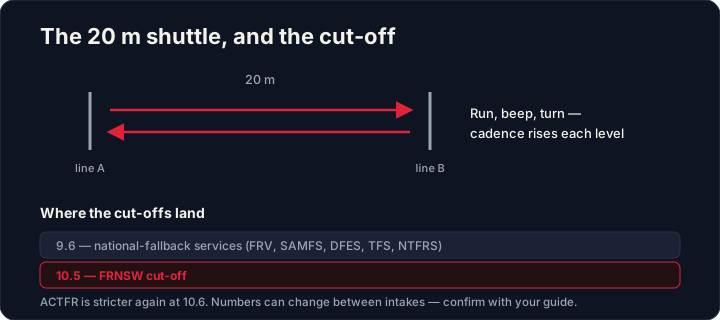
As a training exercise, an audio-paced shuttle run gives you repeated changes of direction and a progressively demanding effort. It can help you observe your pacing, tolerance of repeated acceleration and ability to stay composed as exertion rises.
Those observations are useful without becoming an official score. Record the exercise and conditions consistently if you want to compare your own sessions. A result on a different surface, with different spacing or after a hard workout is not a clean comparison with a fresh attempt.
FirePrep recommends treating this as one optional tool, not the centre of every candidate’s plan. Walking, cycling, running and other appropriate aerobic exercise can also contribute to a sustainable conditioning routine. The choice should reflect your health, injury history and access to safe training.
Pacing: practise control rather than chasing a number
If you include shuttles, start by learning controlled turns and a manageable rhythm. Racing ahead of an audio cue can create unnecessary acceleration and braking. Struggling early is a reason to reassess the session, not proof that you have failed an FRNSW requirement.
Use a clear, non-slip area and enough room to slow safely. Do not add improvised breathing restrictions, heavy kit or exhaustion simply to make the exercise feel more “firefighter-like”. More discomfort does not automatically make a drill more relevant.
A maximal effort can be tiring in its own right. FirePrep does not recommend turning every conditioning session into a personal-best attempt. Repeatable, recoverable training is more useful than a dramatic result followed by disrupted training.
Balance the aerobic work with the rest of preparation
A strong running result cannot tell you how well you control a load or sustain a hold. Equally, a strong lift does not describe your ability to repeat work with composure.
FirePrep’s preparation approach is to build the components separately before combining them:
- Develop a consistent aerobic routine you can recover from.
- Practise progressive carries and pulling with appropriate coaching.
- Build controlled strength endurance, including suitable static holds.
- Review which activity causes your technique to deteriorate, rather than assuming every difficulty is a cardio problem.
These are coaching recommendations, not replicas of the PAT or extra eligibility gates. How hard the FRNSW PAT is explores that distinction in more detail.
Keep the administration alongside the training
A doctor’s medical clearance must reach recruitment by the specified deadline before PAT attendance. source review overdue (review due 2026-10-07); confirm the current candidate information pack. An improving fitness log does not replace the required paperwork.
The physical assessment is also not the whole application. Cognitive, emotional-intelligence and mechanical-reasoning tests plus recorded video interview; online proctoring. source review overdue (review due 2026-10-08); confirm the current candidate information pack. Reserve preparation time for the online assessments and recorded interview, rather than assuming physical preparation covers everything.
For other services, use the service-by-service beep-test guide to identify the applicable protocol. Keep each service’s standard attached to its own pathway.
The FirePrep readiness check can help you decide what to work on next. For FRNSW, that should mean an honest view of your preparation and its gaps—not a pass prediction against an unverified beep-test number.