“How hard is the FRNSW PAT?” is really several questions. Is your current fitness relevant? Are there movements you have not practised? Can you stay controlled when effort rises? And are you working from the right description of the assessment?
The useful answer is not that everyone needs elite fitness or that regular gym attendance makes success automatic. Difficulty is individual. This article offers a FirePrep preparation perspective, not failure statistics, a ranking of the tasks or a pass prediction.
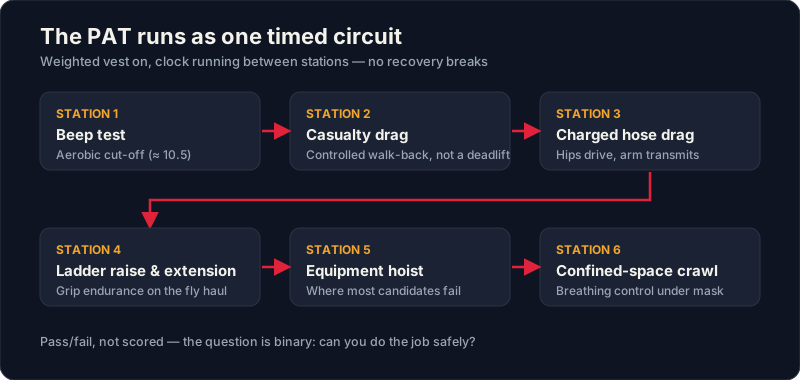
Start with the supported format
Three-stage PAT wearing PPE/ankle weights; walking only; rests continue the clock. source review overdue (review due 2026-10-08); confirm the current candidate information pack.
The task descriptions are:
Untimed reduced-visibility and ladder-simulation tasks precede timed stages. source review overdue (review due 2026-10-08); confirm the current candidate information pack.
Jerry-can carry/stairs, rescue-tool static hold and repeated hose drag; published guidance says generally under 15 minutes. source review overdue (review due 2026-10-08); confirm the current candidate information pack.
Fire attack and rescue; published guidance says generally under two minutes, not an unconditional numeric cutoff. source review overdue (review due 2026-10-08); confirm the current candidate information pack.
Keep the timing relationship with those descriptions: Stage three starts only after the full stage-two 15-minute period; early finish provides recovery. source review overdue (review due 2026-10-08); confirm the current candidate information pack.
Use the actual sequence and read any timing qualifications in full rather than assuming a generic uninterrupted circuit. Detailed video-only loads, distances and technique rules are not confirmed here; follow the current official demonstrations.
The PAT minimums guide develops those points and the administrative requirements. Your current assessment instructions remain the place to resolve practical details not established here.
Why general fitness is only part of preparation
An aerobic routine, strength training or sport can give you useful capacity. But each measures something different from controlling an unfamiliar task under assessment conditions.
FirePrep recommends asking what transfers from your current training and what remains untested. If you lift in short sets with long rests, have you explored manageable sustained effort? If you mainly run, have you developed controlled carrying and pulling? If you train alone, are you comfortable listening to a new instruction before acting?
These questions identify preparation gaps. They do not imply that a runner will fail a carry or that a strong lifter will struggle with endurance. Avoid turning a coaching observation into a claim about whole groups of applicants.
Cumulative fatigue: useful to understand, easy to exaggerate
Within your own workouts, an exercise can feel different after other work. That is a reason to progress toward appropriate repeat efforts—not to assume the official assessment contains no recovery.
The recovery fact above matters. So does the difference between learning a movement and practising it when tired. FirePrep recommends developing control first, then combining manageable activities where appropriate.
If fatigue changes your posture or makes you rush equipment handling, record that as a training observation. Reduce the difficulty and seek coaching rather than proving that you can finish at any cost.
Grip and holds: possible weak links, not universal failure points
Carrying, holding and pulling can place different demands on your hands, shoulders and trunk. Your usual routine may develop some of those capacities more than others.
FirePrep training recommendations include gradual loaded carries and suitable static holds, with attention to posture and recovery. Progress should be repeatable: a longer effort with deteriorating control is not necessarily better preparation.
Grip is not established here as the most common reason for failure, nor is an equipment-hoist station established as deciding most results. Do not let an unsupported “hardest station” story distract you from your actual training needs.
Familiarity and composure also matter
An unfamiliar task can consume attention even when the physical load is manageable. Preparation can include listening carefully, asking for clarification in an appropriate setting and learning not to rush the first movement.
For concerns about reduced visibility or other environments, seek safe, authorised familiarisation or appropriate professional support. Do not recreate restricted spaces alone or exercise with improvised breathing restrictions.
Nor should anxiety be dismissed as “not physical” or treated as evidence that someone is unsuitable. This guide cannot predict an assessment outcome from how a person feels about a task.
A more useful self-review than a fictional pass test
FirePrep suggests reviewing your preparation with questions rather than a single gym score:
- Can you perform your chosen training movements with stable control?
- Are you improving under comparable, recorded conditions?
- Can you repeat manageable work without a major loss of technique?
- Are you recovering well enough to train consistently?
- Do you understand which details are official and which are training choices?
- Have pain, symptoms or uncertainty been addressed with the right professional?
A coach can help interpret training observations, but a homemade circuit cannot establish an official pass. The FRNSW beep-test guide explains why a borrowed shuttle score is not a valid shortcut either.
Give yourself a sustainable preparation plan
There is no universal number of weeks that makes everyone ready. FirePrep recommends a gradual plan combining appropriate aerobic work, strength endurance, movement practice and recovery.
Begin from your current capacity rather than the calendar you wish you had. If time is short, increasing every session’s intensity is not a reliable solution. Resolve injury or health concerns, ask recruitment about unclear instructions and avoid treating an unconfirmed future opportunity as a guaranteed deadline.
Pass the PAT on the first attempt. source review overdue (review due 2026-10-08); confirm the current candidate information pack. The reattempt guide explains the distinction between that policy and questions about a future application.
Remember what physical preparation does not replace
A doctor’s medical clearance must reach recruitment by the specified deadline before PAT attendance. source review overdue (review due 2026-10-07); confirm the current candidate information pack. Put the actual clearance deadline into your plan alongside workouts.
The wider recruitment process also needs attention: Cognitive, emotional-intelligence and mechanical-reasoning tests plus recorded video interview; online proctoring. source review overdue (review due 2026-10-08); confirm the current candidate information pack. Physical confidence should not crowd out reasoning practice, interview preparation or application administration.
Look beyond assessment day too. Paid 13-week course; pass all subjects and arrange accommodation; graduates join operational platoons. source review overdue (review due 2026-10-08); confirm the current candidate information pack. A sustainable routine and willingness to learn are more useful habits than a short burst of exhausting preparation.
Use the full recruitment guide for the broader map and the FirePrep readiness check for preparation priorities. Keep the conclusion honest: you can improve your preparation without claiming to know an official result in advance.