Reaching recruit training changes the preparation question. Instead of concentrating only on an assessment invitation, you need to think about learning, recovery, practical arrangements and how to respond when a new skill does not come easily.
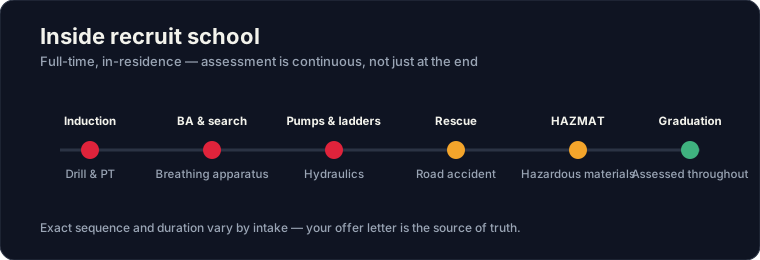
The confirmed career course requirement is: Paid 13-week course; pass all subjects and arrange accommodation; graduates join operational platoons. source review overdue (review due 2026-10-08); confirm the current candidate information pack.
This guide uses that requirement as the starting point for practical planning. It does not invent a detailed syllabus, a daily timetable, a residential entitlement or statistics about which recruits struggle. Your employment and joining instructions should settle those operational details.
Sort practical commitments before arrival
Read the confirmed course requirement above alongside the actual joining instructions. Do not assume “recruit school” means accommodation is automatically supplied, or that a particular commute will work without checking the required attendance arrangements.
FirePrep recommends making a practical plan covering:
- Housing and travel based on confirmed instructions.
- Family, caring and other responsibilities during training.
- An everyday budget, including costs that arise before your first payment.
- Time and space for rest and study.
- The documents and equipment the joining instructions actually request.
Avoid expensive speculative purchases or housing commitments based on someone else’s course experience. Clarify uncertainty with the appropriate contact first.
The duration in the course fact is useful for planning, but it is not a promise about when you personally will start. A historical campaign date or another candidate’s offer does not establish your own timetable.
Keep licensing and checks separate from fitness
Obtain MR before recruit-course placement; applicant pays. source review overdue (review due 2026-10-08); confirm the current candidate information pack.
Put that obligation on its own checklist rather than assuming an earlier application licence check completed every driving requirement. Budget and arrange the relevant steps according to recruitment’s instructions.
The wider check context is: National police, driving and conduct checks; MR licensing required before course placement. source review overdue (review due 2026-10-08); confirm the current candidate information pack. Keep requested records accessible and respond accurately to any outstanding questions.
If you are still planning your route through selection, the full recruitment guide brings the different deadlines together. It is easier to prepare when “before application”, “before physical attendance” and “before course placement” are not collapsed into one vague eligibility list.
You are preparing to learn, not to demonstrate that you already know everything
Previous firefighting experience is not required; recruit training is provided. source review overdue (review due 2026-10-07); confirm the current candidate information pack.
That should encourage honest preparation rather than pretending to have operational expertise. Research the role using current official material, but do not rehearse unfamiliar emergency techniques from unverified videos or buy specialist equipment to teach yourself.
FirePrep recommends building learning habits that transfer across subjects: listen carefully, check what an instruction means, break a skill into manageable parts and review feedback before the next practice.
For theory, try recalling a topic in your own words before looking back at your notes. For practical learning, record the correction you were given and the specific change you intend to make. These are general study techniques, not a claimed FRNSW teaching method.
Treat assessment seriously without guessing the syllabus
The course requirement above establishes the importance of successful study. It does not supply an assessment schedule, a list of graded modules or a rule about how many times a skill can be reassessed.
Ask questions when expectations are unclear. Do not assume that an informal practice result predicts an official outcome or that another recruit’s experience establishes a universal policy.
FirePrep recommends responding to difficulty with a concrete plan: identify the part you do not understand, request the appropriate guidance, practise within the authorised arrangements and review your progress. Hiding confusion tends to leave you without the information needed to improve.
Maintain fitness rather than arriving exhausted
The physical preparation that helped you organise for the PAT can remain useful, but the transition is not an invitation to keep increasing training indefinitely.
FirePrep recommends maintaining an established, recoverable routine while you await confirmed instructions. Avoid a last-minute crash block, unfamiliar maximal lifts or an attempt to prove yourself through pain. If a health concern arises, seek individual advice.
Review training alongside sleep and other demands. Arriving with a personal best is less useful than arriving able to pay attention and engage with learning. This is a preparation principle, not a separate official fitness requirement.
The medical guide explains why training performance cannot substitute for an individual occupational assessment.
Practise being coachable
You can work on receiving feedback before any course begins. In your current job, study or training, ask a trusted person for a specific correction, listen without arguing and show what you changed.
Being coachable does not mean staying silent when an instruction is unclear or a safety concern arises. It means asking constructively, acknowledging uncertainty and using the appropriate supervision rather than improvising.
Supporting others is also a practical habit. Share understanding without acting as an unqualified instructor, respect differences in starting experience and avoid turning every practice exercise into a contest.
Keep expectations about what follows grounded
The current course fact describes the transition after graduation; it does not establish a preferred station, guaranteed location or a complete future promotion pathway. Use the offer and subsequent official instructions for those decisions.
The FRNSW service page provides wider career context. The FirePrep readiness check can help you review preparation habits while you work toward selection, but it cannot predict course success or replace joining instructions.
The most useful aim is simple: arrive organised, ready to learn and able to sustain your effort—not convinced that passing an earlier assessment has finished the work.