“Am I fit enough?” can stop someone before they even understand the assessment. A better starting question is: fit enough for which service, under which instructions? Once you know that, the problem becomes a set of trainable demands rather than a vague comparison with other applicants.
The service requirements below follow current published career guidance. FirePrep’s training suggestions are recommendations, not official thresholds. They do not establish volunteer or retained/on-call fitness requirements.
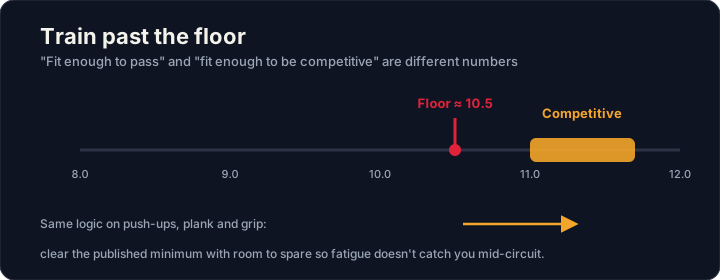
Separate passing from a personal training margin
Passing an official assessment means satisfying its complete rules. A personal margin means being able to repeat your preparation performance without relying on an unusually good day. Those are related ideas, but a margin is not necessarily a better recruitment ranking.
QFD makes that distinction explicit: beep test level: ≥ 9.6 level — Complete level 9.6 in the pass/fail beep test. Higher completion levels do not add merit. source review overdue (review due 2026-10-07); confirm the current candidate information pack. Train beyond a fragile result if it is safe and appropriate, but do not describe extra shuttle levels as merit points.
Nor should you assume every physical assessment uses the same structure. FRNSW states: Three-stage PAT wearing PPE/ankle weights; walking only; rests continue the clock. source review overdue (review due 2026-10-08); confirm the current candidate information pack. ARFF’s sequence is: Order: beep, mid-thigh pull, isometric push-up, countermovement jump. Each must pass; failure ends PAT. source review overdue (review due 2026-10-08); confirm the current candidate information pack. Preparation that ignores the format can miss the actual demand.
What the requirement looks like in practice
For an ACTFR shuttle benchmark: beep test level: ≥ 9.6 level — Reach level 9.6 in the 20-metre shuttle run. source review overdue (review due 2026-10-07); confirm the current candidate information pack. For DFES: beep test level: ≥ 8.7 level — 20-metre audio-paced shuttle run. source review overdue (review due 2026-10-07); confirm the current candidate information pack. The service comparison puts the available shuttle protocols side by side.
But the running result is not the entire picture. DFES’s circuit benchmark is: circuit minutes: < 25 minutes — Circuit performed wearing breathing apparatus or a 14kg weighted vest. source review overdue (review due 2026-10-07); confirm the current candidate information pack. One published example is: Possible circuit task: continuously drag 80kg dummy 30m using shoulder strap. source review overdue (review due 2026-10-08); confirm the current candidate information pack. Preserve “possible” when planning; an example is not a promise that every assessment will contain an identical task.
For FRV’s casualty task: Lift 72kg casualty to chest height; drag backwards 45m including ramp. Readjusting grip is allowed without losing contact. source review overdue (review due 2026-10-08); confirm the current candidate information pack. Grip, lifting technique and controlled movement deserve attention alongside aerobic training. Do not turn the equipment mass alone into a complete readiness score.
Train the relevant qualities, not an image of a firefighter
FirePrep recommends developing aerobic capacity, general strength and controlled movement before adding demanding task-specific combinations. Running, cycling or other suitable aerobic work can support conditioning; resistance training can build the patterns behind lifting, pulling and carrying.
Choose exercises and progressions that suit your health and experience. If you are returning after injury or have concerns about exertion, seek appropriate clinical or qualified exercise guidance rather than copying someone else’s maximum session.
Gym exercises remain training tools. They do not automatically reproduce an official task, especially where the equipment, force measurement or technique is specialised.
For example, ARFF uses: isometric mid thigh pull newtons: ≥ 2300 newtons — Fixed mid-thigh bar/force plates, lifting straps; maximum force held ≥2 seconds; three repetitions. source review overdue (review due 2026-10-08); confirm the current candidate information pack. An ordinary gym deadlift is not a certification of that result.
Sequence and technique can change the result
For TFS: Consecutive tasks: rescue tool, confined space, agility, tower/container, hose drag, firefighter rescue; doctor clearance required. source review overdue (review due 2026-10-08); confirm the current candidate information pack. For FENZ: ppt job circuit seconds: ≤ 495 seconds — Complete the eight job-related PPT tasks in 495 seconds or less. A seven-minute rest follows before the strength/endurance component. source review overdue (review due 2026-10-07); confirm the current candidate information pack. Strength total at least ten; no zero; at most one marginal score. Grip/deadlift use measured body-mass category. source review overdue (review due 2026-10-08); confirm the current candidate information pack.
Those details explain why a collection of fresh gym scores is incomplete evidence. Where tasks are linked, practise safe combinations that reflect the relevant demand. Where the protocol specifies recovery, preserve it instead of adding fatigue to make training seem more authentic.
FRNSW’s recovery structure is: Stage three starts only after the full stage-two 15-minute period; early finish provides recovery. source review overdue (review due 2026-10-08); confirm the current candidate information pack. Its published later-stage timing is: Fire attack and rescue; published guidance says generally under two minutes, not an unconditional numeric cutoff. source review overdue (review due 2026-10-08); confirm the current candidate information pack. Keep that qualification rather than treating typical performance as an unconditional cutoff.
Build a plan you can recover from
Start with a baseline of relevant movements under safe conditions. Record technique, symptoms, perceived effort and recovery as well as times or repetitions. Then choose a manageable progression rather than testing every session to exhaustion.
FirePrep’s longer plan offers a foundation-to-specificity structure; the shorter plan is intended for someone with an established base. Their durations are editorial training recommendations, not service rules or guarantees.
Do not practise heights, confined spaces, restricted breathing or unfamiliar firefighting equipment without appropriate supervision. A safe training substitute may develop capacity without certifying task readiness.
Fitness is not medical clearance or selection
For FRNSW: A doctor’s medical clearance must reach recruitment by the specified deadline before PAT attendance. source review overdue (review due 2026-10-07); confirm the current candidate information pack. Employment medical suitability is a separate question: Occupational physician assesses complete medical history individually; disclose previous and current conditions. source review overdue (review due 2026-10-08); confirm the current candidate information pack.
Keep application documents and study preparation moving alongside fitness. For TFS: Submit selection-criteria statement, CV, two referees and licence details. source review overdue (review due 2026-10-08); confirm the current candidate information pack. A useful training block should not leave you discovering an administrative gap at the deadline.
The readiness check can help identify preparation priorities. Use it to ask better questions and plan your next block, not as official certification that you will pass or receive an offer.